
The Gakurin Lotus Program is an initiative designed to cultivate individuals who, grounded in faith, pursue advanced academic research and contribute to diverse sectors of society both in Japan and globally. By integrating scholarly inquiry with human development, the program seeks to foster learning that responds to the increasingly complex challenges of our time from interdisciplinary and international perspectives.
On March 8, 2026, the Gakurin Lotus Report Meeting was held at the Gyogakuen Campus. The event provided an opportunity for scholarship recipients to present the outcomes of their graduate-level research while engaging in dialogue with selection committee members and experts from Japan and abroad. Through these exchanges, participants were encouraged to reexamine the significance of their work within broader social and global contexts.
The presentations covered a wide range of academic disciplines, including education, engineering, psychology, and chemistry.
In the field of education, a study was presented on the sensory processing characteristics of children with special educational needs and their impact on school life. By examining traits such as sensory sensitivities from a scientific perspective, the research contributes to the development of practical support strategies in educational settings and highlights approaches that respect the individuality of each learner.
In engineering, research on the design and control of variable reduction-ratio mechanisms in robotics was introduced. This work proposes innovative mechanical systems that may enhance robotic performance and holds potential for future applications in industrial technology and social infrastructure.
In psychology, a clinical study explored the emergence and management of “premonitory urges” associated with Tourette syndrome. Based on in-depth interviews with individuals experiencing the condition, the research offers new insights that can deepen social understanding and inform more effective forms of support.
In chemistry, a study on the regioselective synthesis of multi-substituted aromatic compounds using catalytic reactions was presented. This advanced research in organic chemistry has potential applications in areas such as pharmaceutical development and the creation of new functional materials.
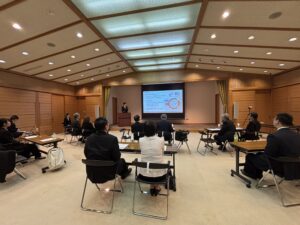
Although rooted in different disciplines, these studies collectively addressed issues closely related to human life and the sustainability of society, revealing a resonance that extended beyond disciplinary boundaries.
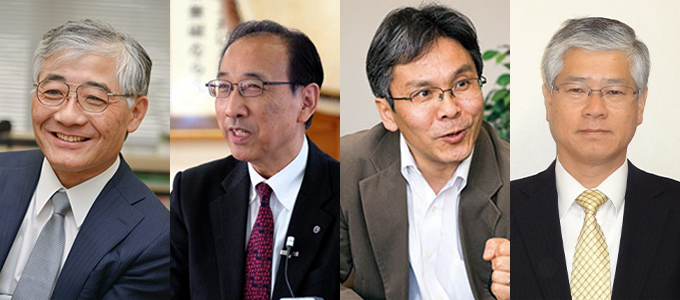
A particularly notable aspect of the event was the dialogue with selection committee members following the presentations. The committee included distinguished scholars and practitioners active on both national and international stages. Their questions went beyond technical expertise, engaging with ethical considerations, social relevance, and connections to global challenges. These exchanges not only deepened the research itself but also expanded its scope toward a broader, global horizon.
Through this process of dialogue, participants came to recognize that their research is not confined to individual academic fields but gains meaning within relationships—with others, with society, and with the wider world. This perspective resonates with a fundamental Buddhist understanding: that all phenomena arise through interdependence.
The presentations also reflected on the personal dimensions of the research journey, including challenges encountered, relationships formed, and moments of self-reflection. These narratives revealed a growing capacity to understand oneself not in isolation, but within a web of relationships—an approach that reflects a Buddhist mode of learning that values both intellectual inquiry and human maturity.
The Gakurin Lotus Program thus goes beyond academic support. It represents an educational approach that nurtures both expertise and a deep sense of responsibility toward others and society. Through dialogue within networks of knowledge in Japan and around the world, the program seeks to open pathways for collaboration that transcend disciplinary and cultural boundaries.
This report meeting demonstrated that each research journey is connected to society and the global community, and that learning rooted in Buddhist values can be further deepened through engagement with diverse perspectives across national and cultural contexts.
Gakurin will continue to cultivate such international and dialogical learning environments, fostering individuals who can contribute to a sustainable and creative future for humanity.