
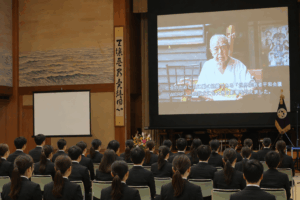
On April 5, 2026, the Gakurin Joint Entrance Ceremony 2026 was solemnly held at the Rissho Kosei-kai Horin-kaku Guest Hall.
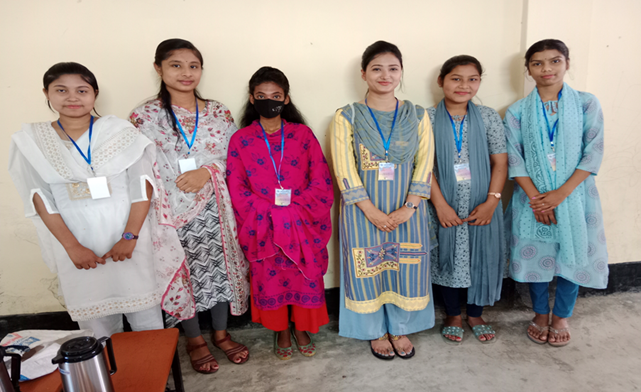
This year, a total of 28 new seminarians entered Gakurin Seminary, including the 63rd Daiju Program, the 52nd Koju University Program, the 19th Gakurin Lotus Program, the 33rd Hoju Program, and the 33rd International Program. Together with participants from Thailand, young people from Dharma centers across Japan began a new journey under a shared aspiration.
During the ceremony, a representative of the new seminarians delivered a pledge, expressing their determination not only to study the teachings of Buddhism as knowledge, but also to embody them through their daily lives and practice.
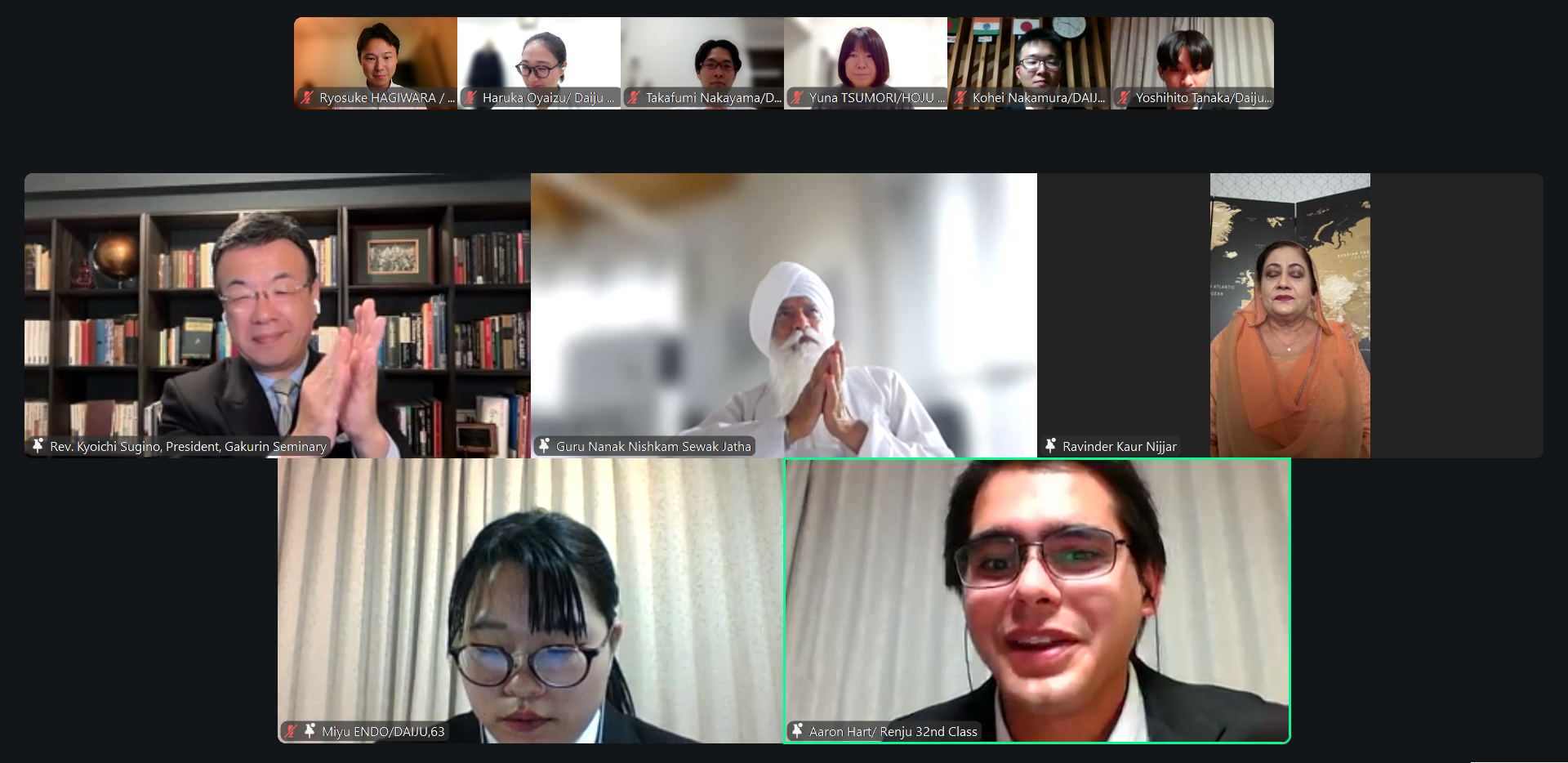
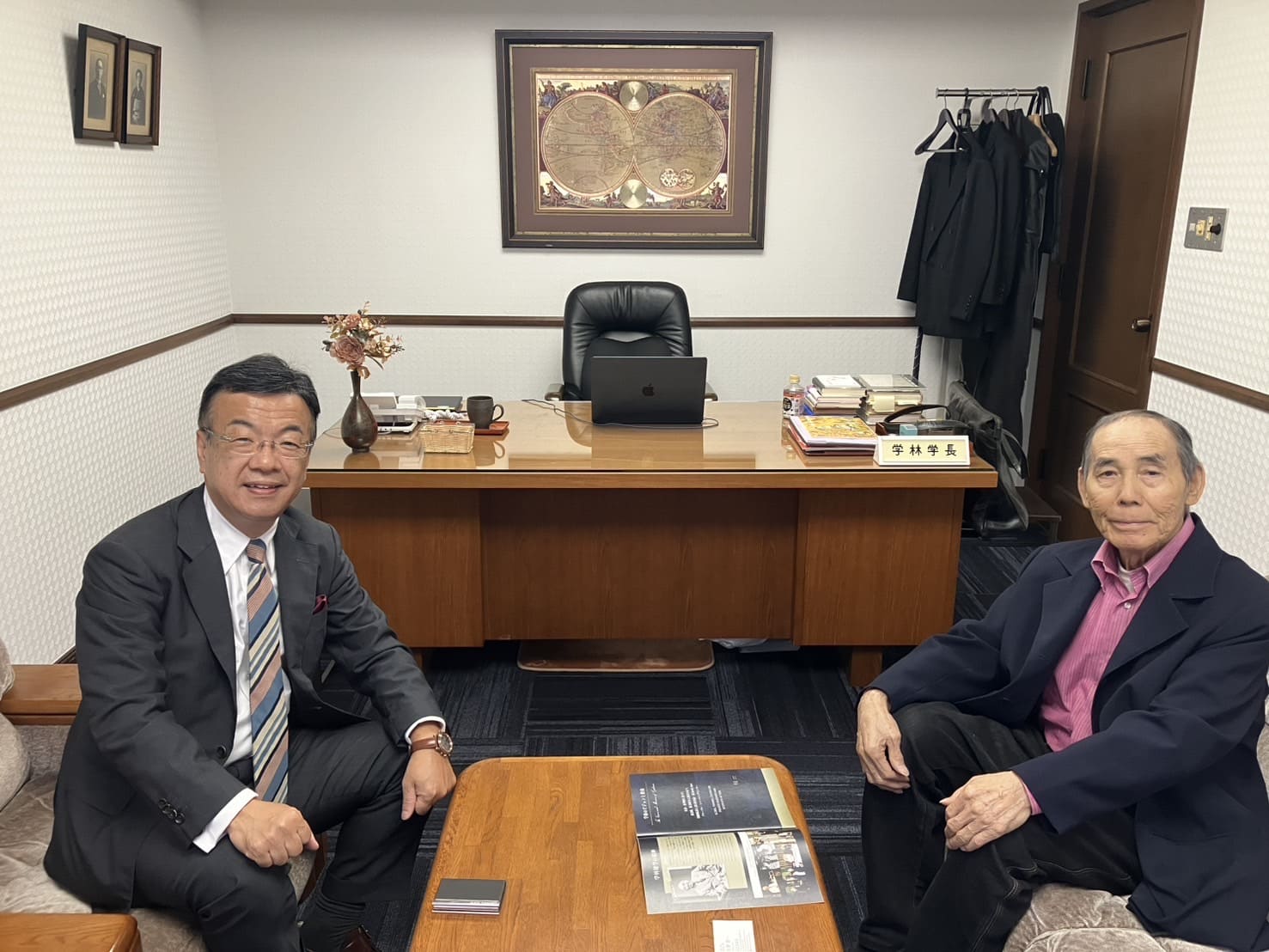
In his address, Rev. Kyoichi Sugino, President of Gakurin Seminary spoke about the spirit of the “Wind from the Future,” referring to a vision articulated by Founder Nikkyo Niwano in 1964. He explained that the founding purpose of Gakurin was to transcend the boundaries of organizations and religious denominations and contribute to the happiness and well-being of all humanity. In a world increasingly marked by division and mistrust, he emphasized that what is most needed is the ability to cultivate peace from within the human heart. He further noted that Gakurin seeks to nurture individuals who possess sensitivity, intellect, and integrity.
A congratulatory message was also presented by Ajarn Sulak Sivaraksa, founder of the International Network of Engaged Buddhists (INEB) and recipient of the 28th Niwano Peace Prize.
Expressing his deep respect for Founder Nikkyo Niwano, Ajarn Sulak highly praised Gakurin’s role as a center for practical Buddhist education. He emphasized that Buddhists must not turn away from the realities of poverty, environmental degradation, violence, and social division that confront the modern world. Rather, they have a responsibility to engage actively with these challenges.
The “Engaged Buddhism” advocated by Ajarn Sulak goes beyond meditation and personal salvation. It is a form of Buddhist practice that embraces the suffering of others as one’s own concern and inspires action toward peace, justice, and harmonious coexistence. He encouraged the new seminarians to cooperate across religious and cultural differences and to take responsibility for addressing the common challenges facing humanity.
In his remarks on behalf of the organization, Chairman of the Board of Rissho Kosei-kai, Rev. Takanori Kumano reflected on life at Gakurin, explaining that human growth comes through both experiences of being hurt and experiences of being healed. He stated that difficulties, frustrations, conflicts arising from communal living, and encounters with people who are different from oneself are never meaningless. Rather, such experiences become valuable nourishment for developing resilience and a deeper understanding of the suffering of others.
President of Rissho Kosei-kai, The Most Rev. Nichiko Niwano then delivered a Dharma Talk to the new seminarians. Holding a photograph of the Earth taken from space, he reminded them that “we all live together on this beautiful planet.” At a time when conflict and division continue around the world, he called upon the seminarians to take responsibility for making the Earth a better place.
The Most Rev. Niwano also introduced roboticist Mr. Masahiro Mori’s metaphor of the “scalpel and the dagger.” Although both are blades, he explained, one becomes a scalpel when used to save lives, while the other becomes a dagger when used to harm others. The difference lies not in the tool itself, but in the heart of the person who uses it.
Furthermore, he spoke about the importance of what he called “flow thinking,” emphasizing that the value of learning lies not in hearing something once, but in continuously returning to it through repeated study and practice. He carefully explained the significance of daily sutra recitation, offerings, and spiritual discipline as means of deepening one’s understanding and transformation.
Finally, through a parable that invited reflection on the question “What is true happiness?” The Most Rev. Niwano taught that genuine happiness is found not merely in material abundance, but in gratitude for life itself and for the blessings present in everyday living.
Learning at Gakurin extends far beyond classroom lectures. Through communal living, community service, and meaningful encounters with others, seminarians cultivate themselves while developing the capacity to engage constructively with society. The new seminarians now begin their journey as bodhisattvas, seeking to apply Buddhist wisdom to the challenges of the modern world and to work together with others in building a peaceful future.
The entrance ceremony served not only as an occasion for the seminarians to affirm their personal formation and social mission as Buddhists, but also as a new starting point for passing on the spirit of Engaged Buddhism—responding to the suffering of the world—to the next generation.
Congratulatory Message for the Gakurin Entrance Ceremony
Founder of the International Network of Engaged Buddhists (INEB) Ajarn Sulak Sivaraksa
I knew Nikkyo Niwano personally, and I have admired him deeply.
He was not only the founder of Rissho Kosei-kai, but also someone who inspired people to establish the World Conference of Religions for Peace, bringing together people of many religions around the world to work for the good of society.
I am very happy that these organizations still exist today, even if some of them now have different names.
His vision also inspired the creation of Asian Religions for Peace.
I am glad that we are celebrating his 120th anniversary.
I am sure we will celebrate him when he reaches 150 years and even 200 years, because in a sense he is immortal. He never dies.
He also inspired the creation of the Gakurin Seminary, which trains people to become Buddhists who can respond to the needs of the modern world.
This is truly tremendous work.
I am happy that many young people are now continuing this good work.
Many of them may not know him personally.
In fact, he did not seek recognition for himself.
Yet his contribution to society and religion is truly tremendous.
I often think of him, and I was honored to receive the Niwano Peace Prize.
Today, an important question for young engaged Buddhists is this:
What challenges should they take on in order to continue Mr. Niwano’s pioneering work?
For young people today, being Buddhist does not simply mean being a good person.
Nor is it about nationalism.
To be a Buddhist today means understanding structural violence and learning how to overcome it through nonviolent ways.
This is very important for young people.
And I have great hope that young people will do even better work than us older generations.
What are the main global challenges today?
It is not only capitalism and consumerism that dominate the world.
Many people are still not fully aware of climate change.
We are also exploiting nature tremendously.
We must learn to respect nature and live in harmony with it.
In this effort, Buddhists must work together with Christians and even non-believers.
We must all work together for the good of the world.
We need to live in harmony with the natural environment.
At the same time, we must build societies that value liberty, democracy, human rights, and human dignity.
My wish is that young people—not only in Japan, but everywhere—move forward positively.
They should work not only for their own lives, but for the lives of all people.
In this way, we truly honor Mr. Niwano on the occasion of his 120th anniversary.